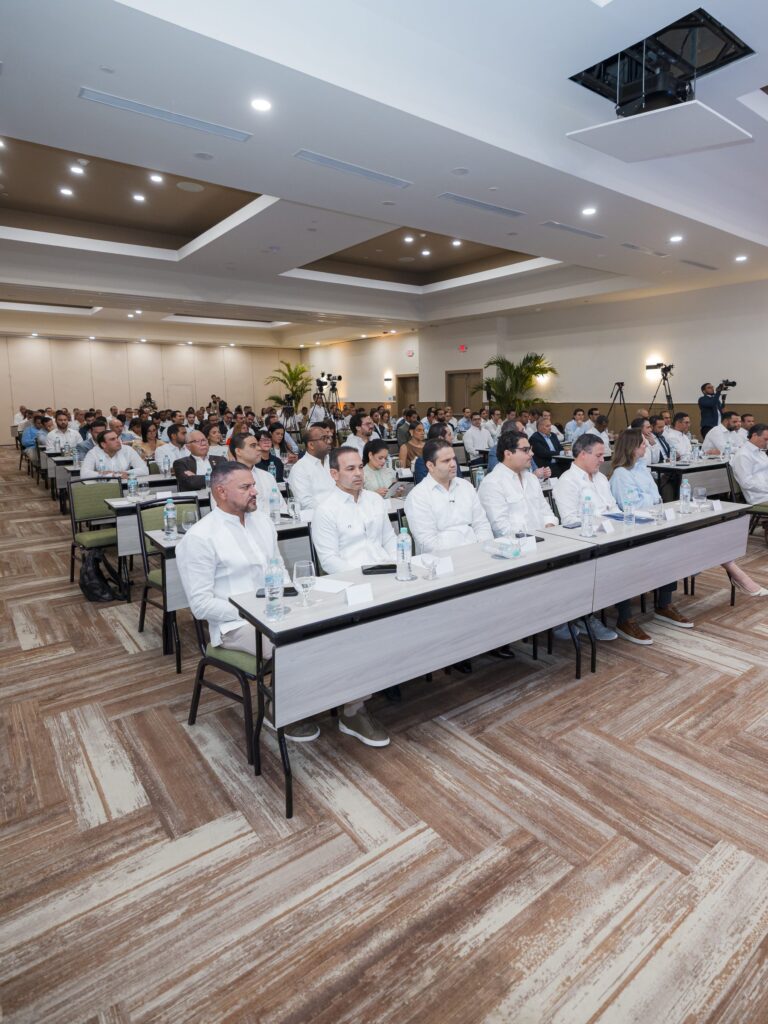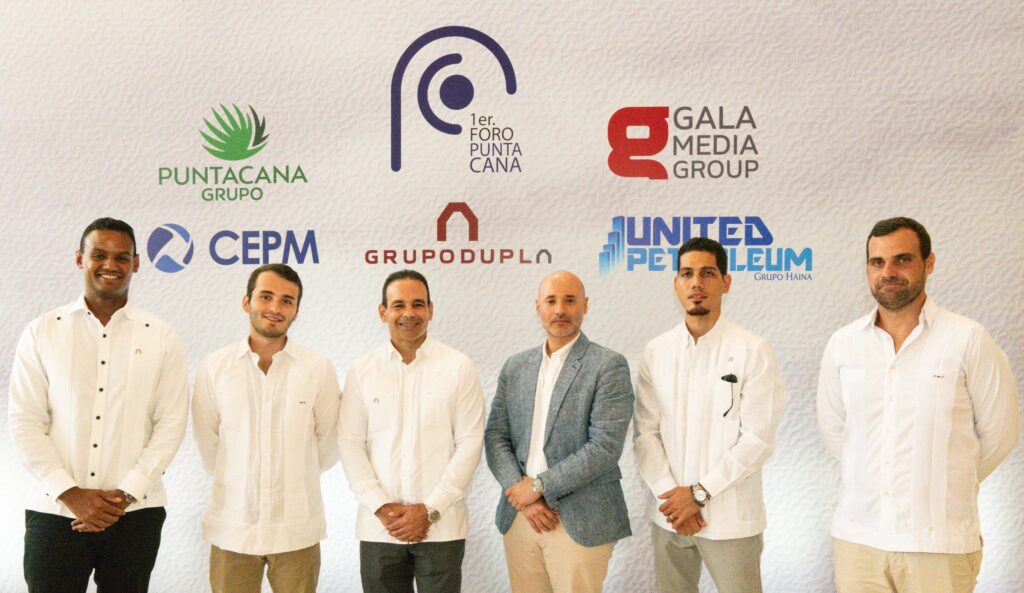

The first Punta Cana Forum 2026, held under the theme “The Country Ahead,” brought together representatives of the public, political and business sectors for a dialogue on the decisions, challenges and transformations that will shape the future of the Dominican Republic. The event included two thematic panels and a closing discussion of the book Joven Político, gathering public officials, legislators, business leaders, journalists, professionals and opinion leaders.
Infrastructure and investment as drivers of development
The first panel, “Infrastructure and Investment: Engines of Dominican Economic Development,” was moderated by journalist Nairobi Viloria. Participants included Jean Luis Rodríguez, Minister of Housing and Buildings; Hostos Rizik, Director General of the RD Vial Trust; Milagros De Camps Germán, Director of Sustainability at InterEnergy Group; and economist and consultant Richard Medina.
“We must continue investing in more and better infrastructure because it is undoubtedly integral to the country’s economic development,” Minister Rodríguez said. He noted that the government has delivered around 15,000 homes nationwide and plans to add another 5,000 in the coming months.
Rizik Lugo highlighted the importance of road connectivity to the country’s growth. “Infrastructure is the engine of development in the Dominican Republic. In terms of regional development, Santo Domingo and Punta Cana are now connected by several highways that make it possible to travel between them in two and a half hours,” he said.
Addressing energy-sector challenges, De Camps Germán stressed the need to strengthen infrastructure and move towards more sustainable models. “We need to increase the resilience of our energy systems, reduce volatility and exposure to fossil fuels, and, more importantly, increase our capacity for energy independence,” she stated.
Economist Richard Medina also underlined the multiplier effect of quality public investment on economic activity. “In the long term, the more quality public investment we make, the more we will grow in the future. Building roads today will help attract more private investment later; this will generate more jobs, consumption and tourists, creating a virtuous circle that drives economic growth,” he explained.
The Punta Cana Forum 2026 was organized by GALA Media Group at The Westin Punta Cana Resort & Club, establishing a platform for exchanging ideas on issues essential to national development.
Legislation, institutions and legal certainty
The second panel, “Legislation and Legal Certainty: Foundations for Investment and Development,” was moderated by journalist Roberto Cavada. The discussion brought together Amaury Reyes, a Constitutional Court judge; Yorlin Vázquez, a Supreme Court judge; Charles Mariotti Jr., a National District deputy for the Dominican Liberation Party; Carmen Ligia Barceló González, a Hato Mayor deputy for the Modern Revolutionary Party; Liz Mieses, a deputy for the Modern Revolutionary Party; Rogelio Alfonso Genao, a deputy for the Social Christian Reformist Party; and Franklin Concepción, a Superior Administrative Court judge.
Participants agreed on the importance of strengthening institutions, establishing clear rules and ensuring a reliable legal framework—essential elements for building confidence, protecting investments and supporting sustainable growth in the Dominican Republic.
“The Constitution is, above all, the foremost plan for social, political and economic development. It tells us that freedom of enterprise and private property are protected, that laws cannot be applied retroactively and that acquired rights cannot be undermined,” Judge Reyes explained.
Judge Vázquez stressed that the judicial system must maintain legal soundness as businesses and new economic dynamics evolve rapidly. “The judiciary and our laws do not move at the same pace as business. Nor should they, because ultimately the justice system must provide users with a sound legal response. All legal innovations and new business models are based on existing law,” she said.
From a legislative perspective, Deputy Mariotti said that the current Chamber of Deputies has worked to address initiatives that had been pending for several years. “This administration has made an effort to settle longstanding obligations of the Dominican Congress,” he noted. He also called for progress on legislation that responds to the challenges arising from the growth of new technologies, including artificial intelligence.
Deputy Barceló González argued that the challenge is not simply to approve new regulations, but to review and improve the existing legal framework. “We do not need more laws. We need to review those we already have. The Dominican Republic needs to develop throughout its territory, not just in certain places,” she emphasized.
Deputy Mieses highlighted the importance of closer ties between the public and private sectors to strengthen investor confidence. “Legal certainty requires closer engagement between government, local government and the business community or investors. We are committed to bringing greater prominence to the National District, Santiago, Higüey and Punta Cana,” she said.
Deputy Genao noted that Congress has important recent legislative tools related to territorial development. “On the legislative side, we have the tools, including recent legislation in Congress such as the regionalization law and the land-use planning law,” he stated, adding that a lack of oversight remains one of Congress’s main weaknesses.
The panel also addressed arbitration as a way to strengthen confidence in investment processes. Judge Franklin Concepción explained that it allows certain disputes to be resolved with reference not only to legal rules, but also to internationally recognized principles and practices. “An arbitration may be decided on the basis of the principles, usages and customs of international business. These customs and rules are not necessarily laws enacted by a congress; they may derive from good practices recommended by organizations,” he explained.
Through the Punta Cana Forum 2026, GALA Media Group reaffirmed its commitment to creating spaces for analysis and conversation that connect different generations, sectors and perspectives around the major issues affecting the development of the Dominican Republic. The organization also announced that the platform will continue in 2027, with new editions examining other strategic issues linked to the country’s present and future.